
Climate-Smart Agriculture: Transforming Rural Livelihoods and Enhancing Food Security in Nigeria
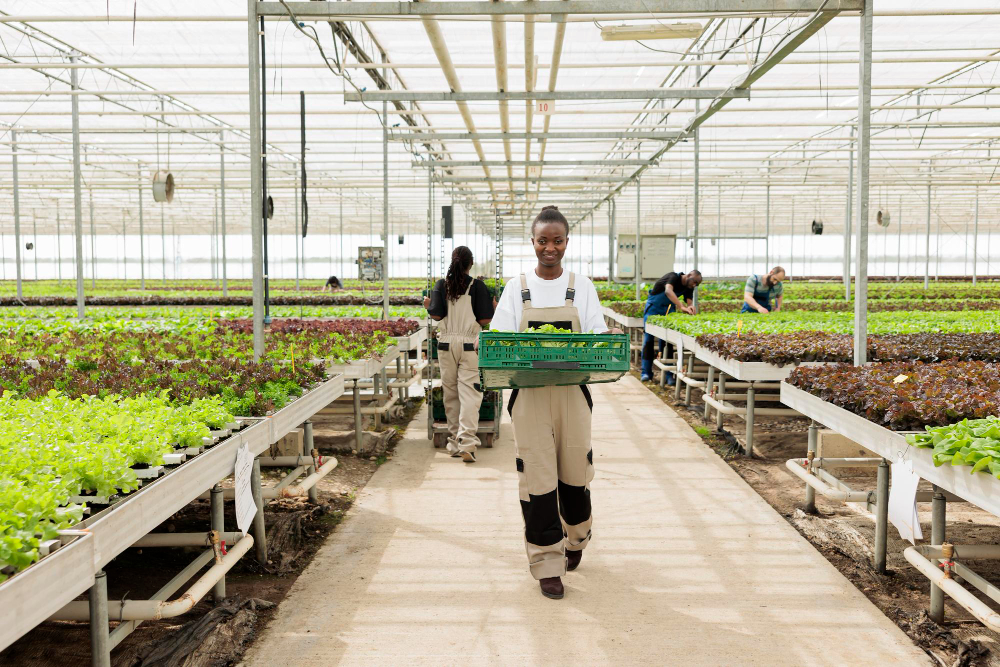
Nigeria does not have a food shortage problem. It has a food systems problem, compounded by erratic weather, entrenched inefficiencies, and policies that often lag behind the climate. Despite employing the majority of the country’s workforce, agriculture contributes just over a fifth to GDP. The sector remains stubbornly low-tech and high-risk, caught between a changing planet and an exploding population. But beneath the surface of this systemic underperformance, something promising is taking root: climate-smart agriculture. It’s not merely a slogan; it’s a strategy that views adaptation not as a retreat but as a process of reinvention.
Across the country, smallholder farmers are already adapting. They are shifting to drought-tolerant crops, adopting low-cost irrigation, and integrating agroforestry practices that regenerate soil and stabilise yields. These innovations prove what matters most: that CSA works. The question now is not whether it can succeed, but how to scale it into national policy, market incentives, and everyday agricultural practice. Doing so will require more than field trials and donor cheerleading. It demands integration between agronomy and economics, policy and practice, tradition and innovation. This is where strategy matters and where Havilah Strategies works with governments, development partners, and rural communities to help shift CSA from scattered practice to systemic response.
What Governments Must Get Right
For decades, Nigeria’s agricultural budgets have favoured the politically convenient over the strategically necessary: fertiliser subsidies, procurement schemes, and stopgap relief disbursed with predictable regularity. However, structural investments that build resilience, such as irrigation, climate-smart infrastructure, and adaptive extension services, remain chronically underfunded. The 2024 federal budget is a case in point: at ₦362 billion, agriculture accounts for just 1.51% of the ₦24 trillion total. That figure falls far short of the 10% benchmark Nigeria reaffirmed under the Maputo Declaration and is woefully inadequate for a country grappling with intensifying climate volatility and growing food insecurity. Contrast this inertia with the Transforming Irrigation Management in Nigeria (TRIMING) project. Backed by the World Bank, it has improved water efficiency, boosted yields, and strengthened rural livelihoods across the northern basin. It demonstrates what works: long-term investment in the physical systems that underpin productivity and adaptation. Solar-powered irrigation, far from being a futuristic luxury, is now a basic prerequisite for farming in a climate-stressed Nigeria.
The country’s extension model is no less outdated. The typical setup, one overburdened agent covering dozens of villages, often equipped with little more than printed pamphlets, is ill-suited to the scale and speed of today’s environmental shifts. Encouragingly, digital platforms like Crop2Cash and Agricorp are bridging some of the gaps, offering real-time weather data, input financing, and market intelligence to farmers via mobile. However, these innovations remain fragmented and under-scaled. The state must stop treating digital tools as experimental add-ons and start integrating them into core extension architecture by investing in rural connectivity, training agents in digital service delivery, and ensuring interoperability across public and private platforms. The tech exists. What’s lacking is institutional adoption.
And then, there is the question of money, not how much is spent, but how intelligently. For CSA to scale, it must be profitable. Governments can and should de-risk private investment by subsidising climate-resilient seed systems, co-financing index-based crop insurance, and anchoring value chains that reward sustainable practices. In Kaduna, emerging models show how structured off-taker arrangements for climate-smart rice are improving both farmer incomes and soil health. International partners have recognised this path forward: the U.S. Global Food Security Strategy Plan for Nigeria (2024–2029) prioritises inclusive markets, nutrition, and climate resilience. But unless such goals are embedded in Nigeria’s own agricultural strategy, with hard budgets and measurable deliverables, they risk remaining just that: goals.
Across Nigeria, smallholder farmers are not waiting for directions from Abuja. Faced with erratic rainfall and rising input costs, they are adapting in real-time, planting drought-tolerant sorghum and cowpea, installing low-cost solar irrigation kits, and reviving agroforestry with shea, moringa, and nitrogen-fixing trees. In Sokoto, improved cowpea varieties have lifted household incomes by as much as 30%. In Taraba, cooperative-led agroforestry efforts are breathing life into degraded soils. These are not pilot projects or isolated anecdotes; they prove climate-smart agriculture is already taking root. But its reach remains patchy, fragile, and largely unsupported by national systems. The challenge now is not innovation; it is scale: aligning public strategy and private capital with the urgency and ingenuity already present in the fields.
Commitments vs. Capacity
Nigeria does not suffer from a shortage of climate-smart strategies. It suffers from a lack of institutional alignment. The National Climate-Smart Agriculture Action Plan, under review since 2021, contains many of the right intentions on paper. But progress from strategy to implementation has been glacial. Meanwhile, donor-led interventions, however effective in isolation, often fail to integrate with national systems or inform medium-term budget cycles.
Fragmentation across ministries deepens the problem. Agriculture focuses on input delivery and productivity. Environment pursues emissions mitigation. Finance, meanwhile, rarely treats either as investment priorities. Coordination exists more in theory than in design. The recently released U.S. Global Food Security Strategy Plan for Nigeria (2024–2029) provides a welcome nudge toward coherence, emphasising climate resilience, inclusive markets, and local ownership. But even the best-laid plans will falter unless federal and state institutions can absorb, fund, and scale their ambitions. Without structural reform of incentives, mandates, and fiscal flows, CSA risks remaining a promising idea confined to PowerPoint decks and donor roundtables.
To move climate-smart agriculture from promising patchwork to national infrastructure, Nigeria must act across four fronts. At Havilah Strategies, we recommend the following immediate steps:
- Convene high-level policy alignment forums: Initiate structured engagement between the Ministries of Agriculture, Environment, Finance, and Water Resources. CSA must become a shared agenda, not a departmental side project. These forums should set joint targets, define shared metrics, and commit to cross-sector implementation plans tied to budget cycles.
- Establish CSA Innovation Hubs in priority zones: Pilot regional centres that bundle CSA training, digital extension, and access to climate-resilient inputs. These hubs should be co-funded by government and private actors and linked to market off-takers. Think of them as decentralised engines of adaptation, places where smallholders can access not just tools but systems.
- Mobilise blended finance for resilient agriculture: Create pooled investment vehicles that combine concessional capital, public guarantees, and commercial funding to de-risk CSA investments. Nigeria’s Development Bank and Sovereign Wealth Fund should partner with donor-backed climate funds to create a national CSA facility focused on smallholder-inclusive value chains.
- Integrate CSA indicators into national reporting: Embed measurable CSA targets within existing monitoring frameworks like the Agricultural Promotion Policy (APP) and National Development Plans. What gets measured: soil health, water efficiency, and climate risk exposure get managed. Without institutionalised tracking, scale will remain elusive.
While these are not silver bullets, they are real levers that are actionable, scalable, and overdue. CSA is no longer a question of innovation. It is a question of scale, structure, and political will. The technologies exist. The farmers are adapting. The strategies have been written. What remains is to connect the dots. With 18.6 million facing acute hunger and 43.7 million Nigerians showing crisis-level hunger coping strategies, for Nigeria, the prize for getting CSA right is not abstract. It is food on tables, incomes in rural homes, and a farming system fit for a hotter, hungrier century. That won’t happen through slogans or scattered pilots. It will take serious coordination, bold financing, and a shift in how agriculture is valued; no longer as a legacy sector, but as a climate solution.
At Havilah Strategies, we believe that resilience is not just the ability to endure the storm; it’s the capacity to grow when the skies clear. And we stand ready to help make that shift.
References
- World Bank. (2022). Transforming Irrigation Management in Nigeria (TRIMING) Project. Retrieved from
https://projects.worldbank.org/en/projects-operations/project-detail/P123112 - International Institute of Tropical Agriculture (IITA). (n.d.). Cowpea: A climate-resilient crop. Retrieved from https://www.iita.org/crops/cowpea/
- Crop2Cash. (2023). Digitizing agriculture for smallholder farmers. Retrieved from https://crop2cash.com
- Agricorp International. (2023). Agricultural transformation in Nigeria. Retrieved from
https://agricorpinternational.com - Federal Ministry of Agriculture and Rural Development (FMARD). (2021). National Climate-Smart Agriculture Action Plan (2021–2030) [Draft]. Abuja, Nigeria.
- Food and Agriculture Organization of the United Nations (FAO). (2015). Climate-Smart Agriculture Sourcebook. Rome: FAO. Retrieved from https://www.fao.org/climate-smart-agriculture-sourcebook/en/
- International Food Policy Research Institute (IFPRI). (2022). Scaling up climate-smart agriculture in Nigeria. Retrieved from https://www.ifpri.org/publication/scaling-climate-smart-agriculture-nigeria
- World Agroforestry Centre (ICRAF). (2021). Agroforestry for sustainable agriculture and climate resilience. Retrieved from https://www.worldagroforestry.org
- National Bureau of Statistics (NBS). (2022). Labour Force Statistics: Unemployment and Underemployment Report (Q4 2020). Retrieved from https://nigerianstat.gov.ng/
- Action Aid Nigeria (2024) Analysis of 2024 Proposed Agriculture Budget. Retrieved from https://nigeria.actionaid.org/publications/2023/analysis-2024-proposed-agriculture-budget
- Nigeria Economic Summit Group (NESG) ( Retrieved from https://nesgroup.org/blog/NESG-Issues-a-Policy-Brief-on-the-Status-of-Food-Security-in-Nigeria